For the one who was hurt
The Safety Plan
"How do I say this without being re-wounded?"
- Sit still before you speak
- Quiet the urge to react
- Get emotionally honest
- Surrender the need to be right
- Choose your presence
- Seek counsel
- Wait

Scan to RSVP
Book Launch & 30-Year Anniversary Celebration · Sunday, November 1 · Grace Family Church, Lutz
Presented by Replace Your University
neverfightorargue.com/book-launch

Presented by Replace Your University
A happier, stronger marriage is possible
Discover biblical conflict resolution for couples who have tried everything. Learn practical tools to create safety, restore connection, and communicate without destructive conflict.
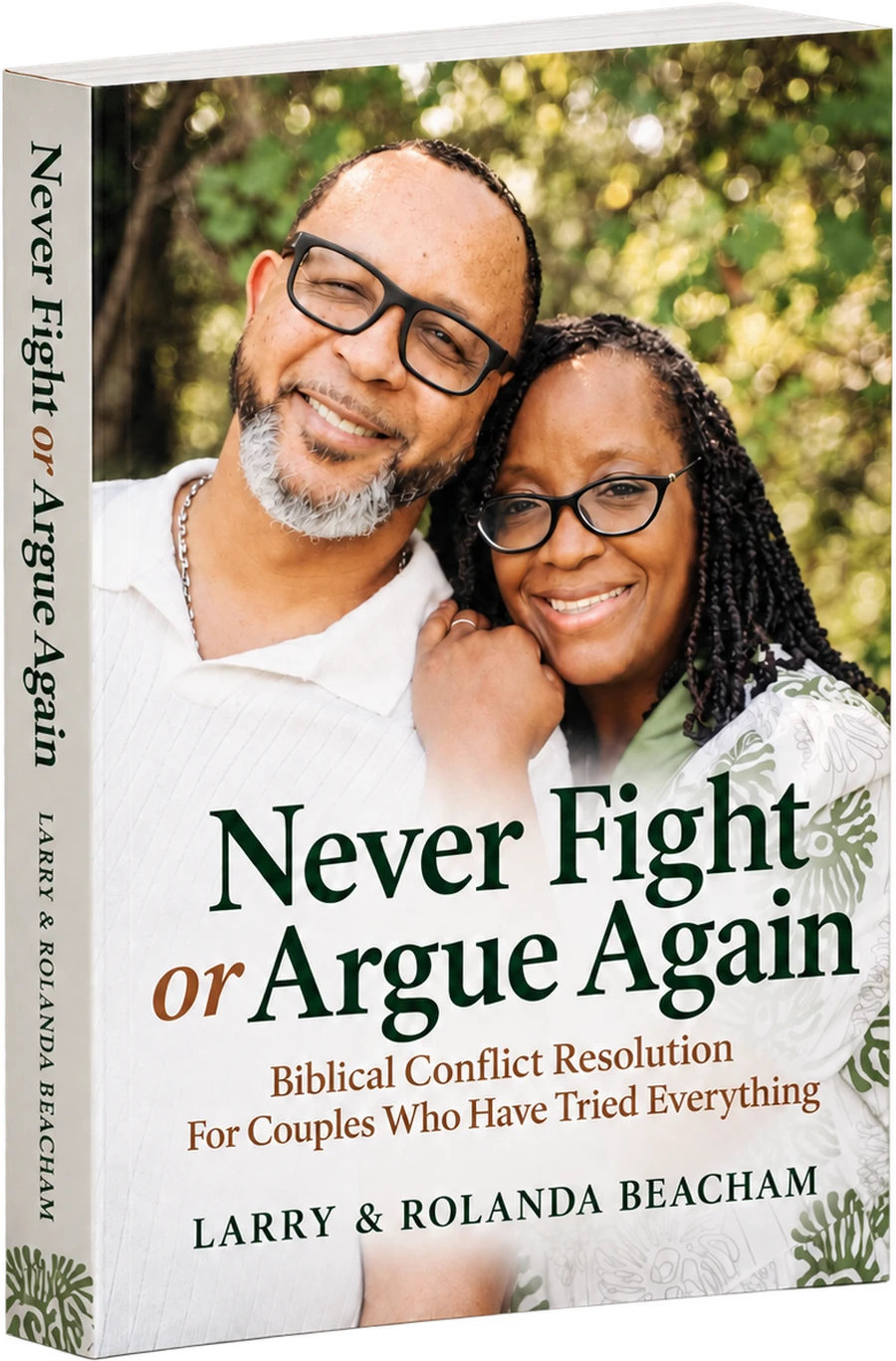
By Larry & Rolanda Beacham
Free instant download • No spam • Unsubscribe anytime
Why fighting fair isn't good enough
And above all, to God, who never once taught us how to fight better. Only how to stop.
Nearly every book, seminar, and counseling session says the same thing: conflict is normal, so learn to manage it. Stay calm. Listen actively. Don't attack the person. It's decent advice, and it beats shouting matches and cold wars. But underneath it sits an assumption almost nobody questions: that conflict, even handled well, has to stay a permanent feature of your marriage.
That's like telling a pilot to crash more gracefully instead of teaching them to fly higher and avoid the crash altogether.
Conflict and fighting are not the same thing. Conflict is two people who see something differently. Fighting is what happens when one or both of them arrive unprepared. The difference isn't temperament or luck — it's preparation. And preparation can be learned.
The plan
Most couples walk into a hard conversation the moment one of them can't hold it in any longer. Both arrive unready — one carrying pain, the other bracing for impact. This book gives each spouse their own path to walk first.
For the one who was hurt
"How do I say this without being re-wounded?"
For the one who caused it
"How do I become someone this is safe to say to?"
Where they meet
When both people arrive safe, surrendered, and Spirit-led, the goal stops being to win and starts being to become one. Fighting doesn't get managed. It becomes irrelevant.
Let's start with the objection
"That's not realistic."
"Every couple argues."
"You can't avoid conflict forever."
It doesn't mean you'll never be upset, never disagree, or always feel close. It means disagreement stops turning into disconnection. Specifically:
Disagreements don't have to be detonations. They can be doorways.
Start reading free
We'll send Chapter One — the case against fighting fair, and why "learn to fight better" was the wrong advice all along. Ten minutes is enough to know whether this is the book your marriage needs.
After that, occasional notes from Larry and Ro. Nothing heavy, and you can leave any time.
Send Me Chapter One
Free to read tonight. Sent the moment you hit send.
For churches & ministries
The book, the companion workbook, and the full video course work together, so a small group, a marriage ministry, or a whole congregation can walk the plan at the same pace.
Paperback and ebook, with a chapter-by-chapter discussion guide built in for group study.
Guided exercises for each plan, filled in separately by each spouse and then brought together.
Session videos with Larry and Ro, leader notes, and everything a facilitator needs to run it.
The book
Most marriage books hand you principles and wish you well. This one hands you a sequence — what each spouse does before the conversation, what happens during it, and how you get back on track when an old habit shows up again.
Never Fight or Argue Again
Written by Larry and Rolanda Beacham out of years of learning — often the hard way — that fighting fair still wasn't the same as not fighting at all.
How it's built
Renewing your mind about marriage and communication. The real difference between conflict and fighting. The call to maturity, and what it means to invite God into the middle of a disagreement rather than after it.
The Safety Plan for the spouse carrying the hurt. The Readiness Plan for the spouse who caused it. Then the Anti-Fight Plan, where the two paths meet and the conversation actually happens.
Forgiveness and fresh starts. What to do when old habits try to return. Becoming a safe place for each other, and leaving a legacy of peace that outlasts you.
The tools
Not theory. Things you and your spouse can call by name, in the moment, when it matters.
Adoration, Confession, Thanksgiving, and Sharing truth in love — the gospel's own order for entering a hard conversation. Own what's yours before you name what isn't.
Listen, Understand, Validate. When your spouse finishes telling you something hard, they aren't looking for resolution yet. They're looking for recognition.
Borrowed from investing: exit early to prevent deeper loss. A pre-agreed cue, a fixed pause, and a real plan to come back — so pausing never becomes walking away.
"Don't worry about how I'm saying it" isn't how safety works. Bringing all three dimensions into alignment, so your face doesn't contradict your sentence.
The same way a drive-thru repeats your order before it moves on. Say back what you heard, in their words, before you offer anything of your own.
Questions for reading alone, as a couple, or in a small group. Slowly is fine — you don't have to answer them all in one sitting.
Who it's for
Get the book
Paperback and ebook, releasing Sunday, November 1, 2026. Available wherever you prefer to buy books.
Store links go live on launch day. Until then, two things you can do right now:
Signed copies, bulk pricing, and church rates are available directly from us. Ten copies or a hundred — same conversation.
Church & bulk ordersThirty years ago we said “I do.” On November 1st we’re marking that anniversary the only way that makes sense to us — by launching Never Fight or Argue Again, the book those thirty years taught us to write. Come celebrate with us.

Presented by Replace Your University


Thank you for registering
We’ve saved you a seat.
A confirmation is on its way to your inbox.
Nothing else is needed from you —
just show up.
Add to calendar · Directions · Chapter One (free)
Presented by Replace Your University
We can’t wait to celebrate with you.
Better conversations.
A brighter tomorrow.
Beat The Line At The Launch
Secure your copy before the event and enjoy exclusive event-night perks when you arrive.


Order More & Save
Buy one copy or save more when you order multiple.
| 1 Copy | $20 total | $20 each | Standard Price |
| 2 Copies | $38 total | $19 each | Save $2 |
| 3 Copies | $54 total | $18 each | Save $6 |
| 4 Copies | $64 total | $16 each | Save $16 |
| 5 Copies | $75 total | $15 each | Save $25Best value |
More copies. Bigger savings. A stronger tomorrow together.
Biblical Wisdom|Practical Tools|Real Change
Before the night
Please do. If your headcount has changed since you registered, just reply to your confirmation email and tell us the new number — it helps us set out the right number of chairs.
No — we're not able to provide childcare for this one, so please plan accordingly. The evening is built for adults and runs about two hours.
Refreshments will be served. Not a full meal, so eat beforehand if you're coming straight from work.
Yes, and we'll be signing copies. Come find us afterward — we're in no hurry to leave.
Doors open at 5:30 pm. Come early if you can; we'd genuinely rather meet you than start on time.
Whatever you'd wear to church or out to dinner. Nobody is dressing up for this.
Not at all, and you won't be the only one. Nothing on the night asks you to pair up, speak, or share anything about your marriage in front of anyone.
No. There's nothing to print and no ticket to show — we'll have your name.
Every email we send has a link to let us know. No awkwardness in it — it just frees the seat for someone else.
Reply to your confirmation email and tell us what you need. We'll sort it with the church and come back to you well before the night.
Your seats for November 1st are reserved — the confirmation is in your inbox.
Sponsor the night & be recognized
On Sunday, November 1st we launch Never Fight or Argue Again and celebrate thirty years of marriage in the same room, at Grace Family Church in Lutz. A full house of couples, pastors and families from across Tampa Bay. Sponsors make the evening free for everyone who walks in — and are thanked in front of all of them.
How this works
Sponsorship levels · for businesses & ministries
A full house of married couples, pastors and families from across Tampa Bay. Choose a level → we call within a business day → invoice (card, Zelle or check) → logo by October 18th.
Secured
$2,500
One available
$1,500
Three available
$1,000
Secured
$750
Six available
$500
Secure your sponsorship
No payment is taken here. This reserves your level; we call to confirm, then send a secure payment link, Zelle details, or an invoice — your choice.
Questions sponsors ask
Sponsorships are paid to Larry & Rolanda Beacham, not to a registered charity, so they are generally treated as a marketing or advertising expense for your business rather than a charitable gift. Please check with your accountant.
Yes — reserve each one separately, or tell us in the message box and we'll put it on one invoice.
We'll call you the same day and offer the closest alternative. Nothing is charged until you say yes.
Gold, Presenting and Reception sponsors get a display table at the reception. A pull-up banner is welcome; we'll confirm the space with the church.
Absolutely — Silver Sponsor works well for individuals and families, and anyone can also gift a signed copy.
Email larry@kdmcommunity.com or reply to any email from us — it comes straight to Larry.
Sponsorship reserved
We've reserved your sponsorship and emailed you the next steps. Larry or Rolanda will call within one business day to say thank you properly, confirm the details, and get an invoice to you.
One thing you can do right now
The evening costs nothing to attend. Not every couple will leave with the book — and some of the couples who'd benefit most are the ones who'd never ask.
$20 — the price of the book — covers one signed copy. We hand it to a couple on the night, from us, with your name on the card inside if you'd like it there. You'll never know who they were. They'll never forget somebody did it.

Secure card payment through Stripe — choose how many copies on the next screen. Anyone who gifts five or more is named in the printed program.
Gift received
Your gift is confirmed and Stripe has emailed you a receipt. On November 1st we'll hand a signed copy to a couple, with your name on the card inside if you gave one. You won't know who they were. They won't forget that somebody did it.
Internal · sponsorship invoicing
Pick the level they reserved. You'll get the secure Stripe link for that amount and a message to paste into a text or email. Stripe emails them a receipt and an invoice automatically, and the payment shows in your dashboard.
Zelle or check instead? Reply to their reservation email with the details, and mark the row paid in Supabase when it lands.
Payment received
Your sponsorship is confirmed and paid. Stripe has emailed your receipt and invoice. Two things left: reply to any of our emails with your logo (PNG or SVG) by October 18th, and we'll see you on November 1st — your seats will be waiting.
Be a blessing
$20 — the price of the book — puts a signed copy in another couple's hands on November 1st. We hand it to them, from us, with your name on the card inside if you'd like.
How many copies?
You can still change the number on the next step.
Secure payment
Sponsorship payment
Complete your sponsorship of the Never Fight or Argue Again book launch & 30-year anniversary celebration, Sunday November 1st at Grace Family Church.
Secure payment
Beat the line
$20 — the same as at the table — and you skip the line on November 1st.
How many copies? Buy more, pay less per copy
1 copy — $20
$20 for one. 2 copies $19 each, 3 for $18, 4 for $16, and 5 or more just $15 each. You’ll be asked who to sign them to on the next step.
Secure payment
You beat the line
Your pre-order is in and a confirmation is on its way to your inbox. On November 1st: give your name at the door, take your reserved seat, and show your pickup pass at the express table for your signed copy and the laminated Frameworks Bundle — no line.
Express pickup pass
Never Fight or Argue Again · Book launch
Loading your pass…
Show this screen at the express table on Sunday, November 1st (doors 5:30 pm, Grace Family Church, Lutz). Your signed copy and the laminated Frameworks Bundle are waiting.
Volunteer
Express table · volunteers
Enter the PIN Larry gave you. The list updates itself as people pre-order, so there’s nothing to print.
Express table
Tip: scanning someone’s QR with this phone opens their pass with a “Mark as picked up” button.
Beat The Line At The Launch
Secure your copy before the event and enjoy exclusive event-night perks when you arrive.
Order More & Save
Buy one copy or save more when you order multiple.
| 1 Copy | $20 total | $20 each | Standard Price |
| 2 Copies | $38 total | $19 each | Save $2 |
| 3 Copies | $54 total | $18 each | Save $6 |
| 4 Copies | $64 total | $16 each | Save $16 |
| 5 Copies | $75 total | $15 each | Save $25Best value |
More copies. Bigger savings. A stronger tomorrow together.
Biblical Wisdom|Practical Tools|Real Change
Book launch · November 1
Updates itself every 60 seconds as people register.
Free chapter
Updates itself every 60 seconds as people opt in.
For churches & organizations
Most marriage studies teach couples to communicate better inside the same old pattern. This one changes the pattern — and it gives each spouse something specific to do, which is usually the difference between a group that shows up week four and a group that doesn't.

Why leaders reach for this
You can win the argument — or you can be the place they never have to argue again.
They've heard the sermons. They know the verses. What they're missing is a sequence — something concrete enough that a husband knows exactly what to do on Thursday night when he can tell his wife is hurt and he doesn't know what to say.
This material gives both spouses their own assignment. The one carrying the hurt works a Safety Plan. The one who caused it works a Readiness Plan. Neither is waiting on the other to go first, which removes the standoff that stalls most marriage ministry.
It's Scripture-anchored throughout, written by a couple who needed it themselves first, and it doesn't require a licensed counselor in the room to lead well.
The curriculum
Three pieces that work on their own or together. Take the book to a small group, add the workbook when couples are ready to do the exercises, or run the whole thing with the video course and let us carry the teaching.
Start here
The complete plan, with a chapter-by-chapter discussion guide already built in for group study.
Go deeper
Guided exercises for each plan, worked separately by each spouse and then brought together.
Run the series
Session videos with Larry and Ro, plus everything a facilitator needs to run the study without prep-heavy weeks.
Ways churches are using it
Work through the book using the built-in discussion guide. Homes, campus, or online. Couples read between sessions and practice one tool at a time.
The two preparation plans taught side by side, with guided practice time so couples leave having already had one conversation the new way.
Engaged couples learn the plan before they've built ten years of habits to unlearn. Pairs naturally with existing premarital counseling.
Give couples structured homework that reinforces what happens in the room, and a shared vocabulary your counselors can reference by name.
Weekend messages paired with group study, so the whole congregation is working the same material at the same time.
Ministry marriages carry unusual pressure and unusually little permission to say so. Several churches start here before rolling it out.
Talk to us
Whether you need twelve copies for a small group or you're mapping out a church-wide series, send the details and we'll come back with pricing, timing, and the format we'd recommend for your group.
Prefer email? churches@neverfightorargue.com
Curriculum & bulk inquiry
We read every one of these ourselves.
Speaking & couples ministry
Larry and Ro teach this material the way they learned it — plainly, as two people who needed it first. No performance, no polished couple on a stage pretending the hard years didn't happen.
Formats
A single message on conflict versus fighting, and what changes in a home when a marriage stops keeping score. Works as a stand-alone or as the launch of a group series.
The Safety Plan and Readiness Plan taught side by side, with protected practice time so couples leave having already had one conversation the new way.
A multi-week study built on the book's discussion guide, for groups meeting in homes or on campus. We can teach it or train your leaders to.
Focused private sessions for couples who need to work through the plan with someone in the room. Limited availability.
What it sounds like
Peace isn't found in avoiding conflict. It's found in choosing connection — even inside it.
Larry and Ro don't teach conflict resolution as a set of techniques. They teach it as something two people become, then hand the room the specific steps to get there. Expect honesty about their own marriage, Scripture that isn't decorative, and tools people can use before they get home.
Check availability
Send the date, the format, and roughly who'll be in the room. We'll come back with availability and what we'd suggest for your group.
Prefer email? speaking@neverfightorargue.com
Speaking inquiry
We'll reply within two business days.
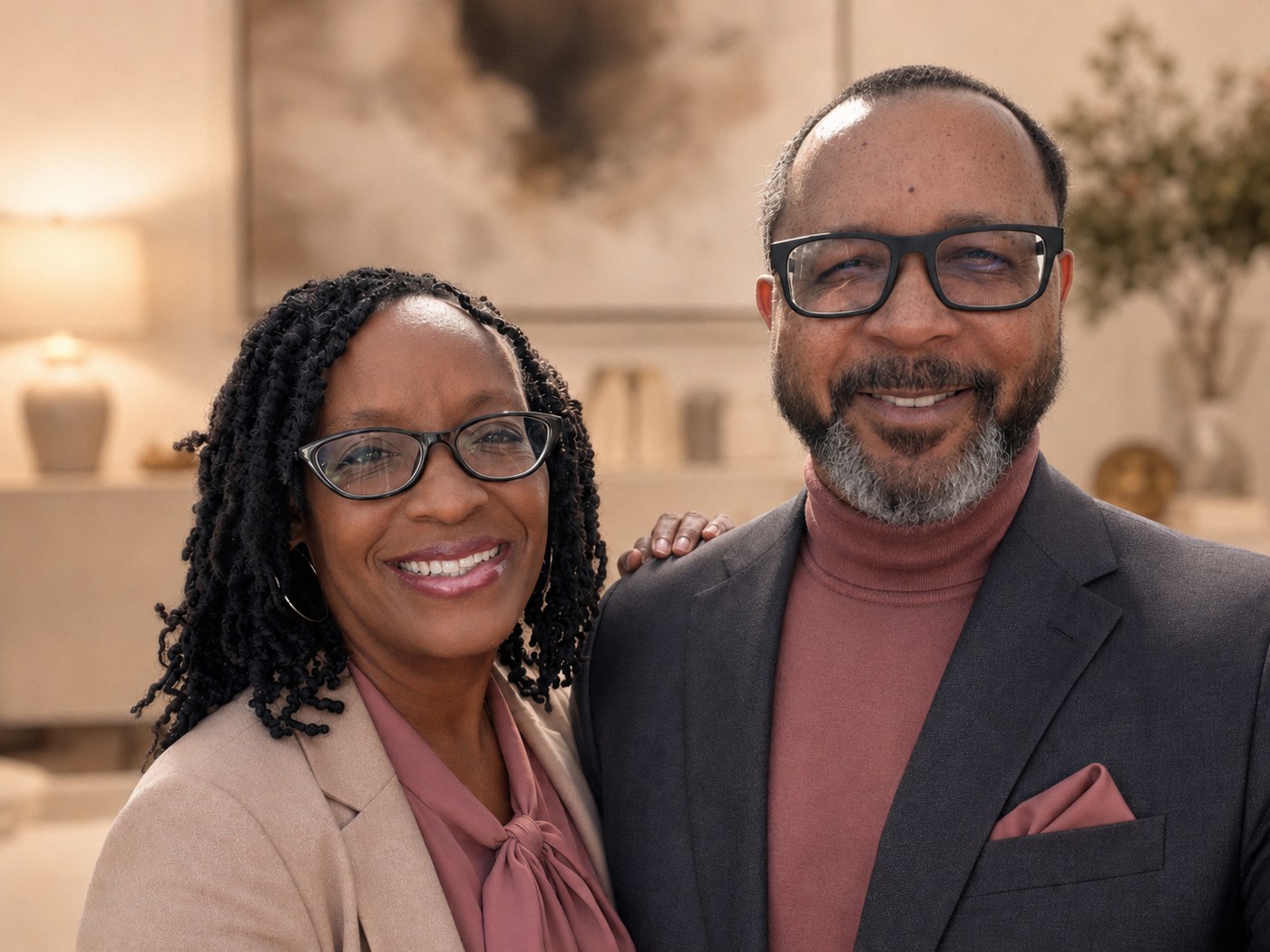
About the authors
A husband-and-wife team devoted to helping couples move from conflict to real connection — starting with the years they spent learning it the hard way themselves.
Their story
They did what the books said. And they still kept ending up on opposite sides of the same room.
Larry and Rolanda learned that the long way. They stayed calm, listened actively, kept it clean — everything the advice told them to do.
What eventually changed things wasn't a better technique. It was realizing that both of them were walking into hard conversations unprepared — one carrying pain with nowhere safe to put it, the other bracing for impact and reaching for a defense. Out of those years came the Safety Plan and Anti-Fight Plan framework at the center of this book.
It has since shaped how they lead their own marriage and how they walk alongside other couples. They live in Odessa, Florida, and are parents to Taylor, Bryant, Lauryn, Manny, Ari, and Trey. Never Fight or Argue Again is their first book.
In their words
And above all, to God, who never once taught us how to fight better. Only how to stop.
They're quick to name the people who got them here: mentors, pastors, and counselors who told them the truth they needed instead of the thing they wanted to hear. Chris and Vanessa Davis, who laid a foundation and taught them what resolving conflict in a godly way actually looks like. Pastor Ralph Johnson of Grace Family Church in Tampa, whose wisdom carried them through some of their toughest moments. And their six children, who lived through the years their parents were still figuring it out.
Work with Larry & Ro
They speak at weekend services, marriage retreats, and small-group series, and work with churches building marriage ministry from the ground up.
Send Me Chapter One
Free to read tonight. Sent the moment you hit send.
Testimonials
These are couples we've walked with. We're grateful they were willing to say out loud what most of us keep quiet.
Shorter takes
Written notes from couples and group leaders. Replace each of these with a real one as they come in.
Placeholder quote. Two or three lines is the sweet spot — long enough to say something specific, short enough to read at a glance.
Placeholder quote. The best ones name the exact thing that changed, not just that something did.
Placeholder quote. A group leader's angle works well here — what it was like to run this with other couples.
Your turn
We'd love to hear it, and with your permission we'd love to share it. A short note is plenty — no need to be polished about it.
You can win the argument — or you can be the place they never have to argue again.
Endorsements
People who spend their working lives in other people's marriages, on whether this material holds up.
Placeholder for your strongest endorsement — the one you'd put on the back cover. Give this one room to run three or four lines, because the lead endorsement is doing the most work on the page.
Endorser Name
Title · Church or organization
More endorsements
Placeholder endorsement. Two or three lines works best here — specific about what the book does rather than general praise.
Endorser Name
Senior Pastor · Church Name
Placeholder endorsement. A clinician's angle is worth its own slot: what this adds that standard communication training doesn't.
Endorser Name
Licensed Marriage & Family Therapist
Placeholder endorsement. Someone who has actually run the curriculum with a group carries real weight with other churches.
Endorser Name
Marriage Ministry Director · Church Name
Placeholder endorsement. An author endorsement helps with retailers and reviewers, so keep this one quotable and short.
Endorser Name
Author · Book Title
For reviewers & media
We're glad to send a review copy to pastors, counselors, ministry leaders, and podcast hosts. Tell us a little about your audience and we'll get one out.
You're in
Chapter One is on its way, from Larry & Rolanda Beacham. If it hasn't landed in a few minutes, look in Promotions or Spam. Move it to your main inbox once and your email app will put the rest of our notes there too.
Download Chapter One Read in browser
No need to wait for the email — the chapter is yours right here.
You're invited
We're launching Never Fight or Argue Again live at Grace Family Church in Lutz — not a webinar, an actual room with actual couples in it. We'd love to have you there.
Doors at 5:30 pm, free to attend. Reserve a seat so we know to expect you.
Members only
It takes about ten seconds. Add your name and email and we'll unlock the chapter here and send a copy to your inbox.
Send Me Chapter One
Unlocks here immediately, and a copy goes to your inbox.
Your free chapter
Notice, as you go, which of the two plans you'd be working. Most people know within a page or two — and knowing which side of the conversation you're on is the whole starting point.